
 Christmas Card Collections
Blog Posts
The Other Train Landscape.
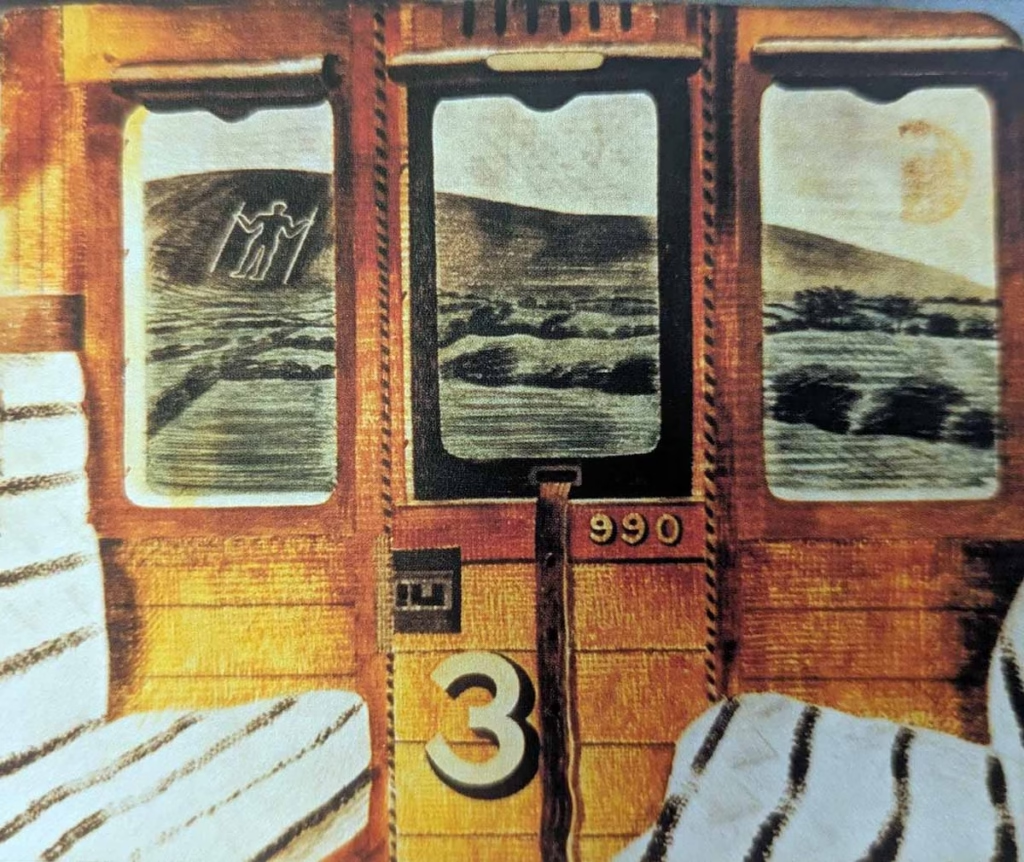
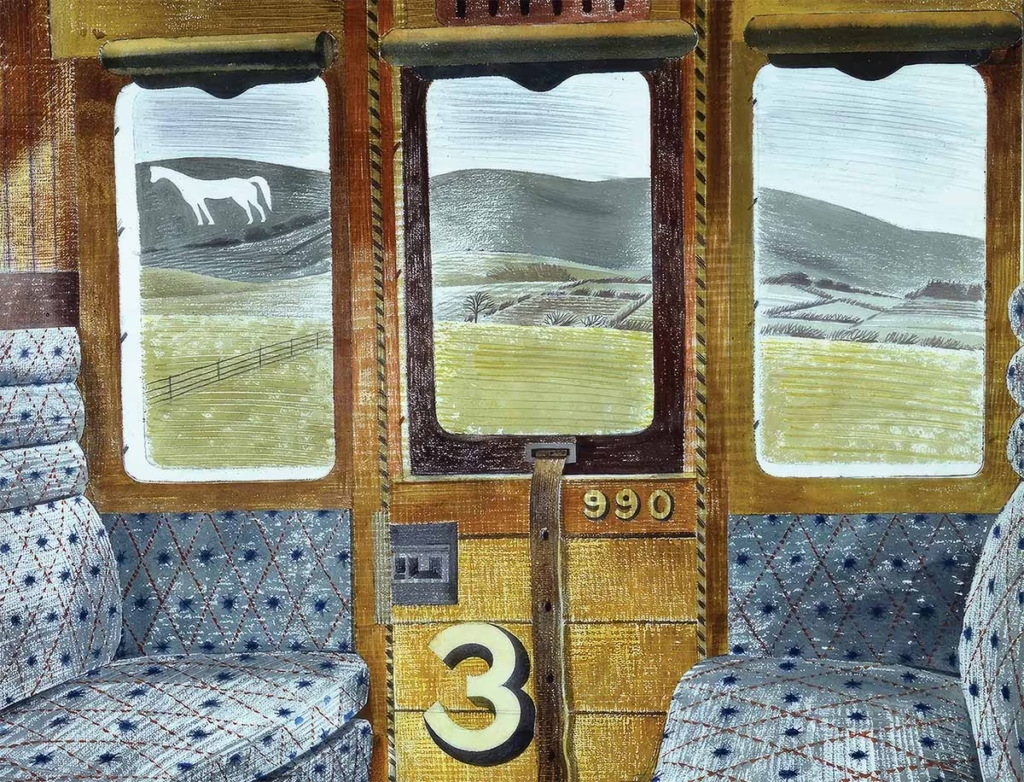
‘He often doctored paintings that went wrong and when he painted two attempts at railways carriages on the Eastbourne and Hastings train, neither of them of which he wholly approved, I cut them up and joined together the best bits and made a satisfactory whole.’
Tirzah Garwood, Long Live Great Bardfield. Persephone books, P.350.
Train Landscape by Eric Ravilious was voted the nation’s favourite railway art in 2025, and arguably remains his best known work. But did you know it is a collage of two of his paintings?
There was always something about this painting that nagged at me. Ravilious’ other depiction of the hill figure, albeit from a different perspective, is titled Westbury Horse (suitably enough) and has a very different feel to it – it’s much more stylised – the ear is sharply pointed, and the snout more reminiscent of a sea-horse than the mammalian kind. A single circle of turf depicts an eye – the only internal feature of the geoglyph. Rainfall has washed surface chalk and soil into cone-like shapes descending from its hooves, as if the horse was standing above a reflection of itself.
As for the contours of the hill itself, the lowest rampart of Bratton Hillfort slides around the hill and fades to a stop just under the nose of the horse, with the middle rampart cutting in just above the point of the ear, and the uppermost rampart describing the upper limits of the earthwork.
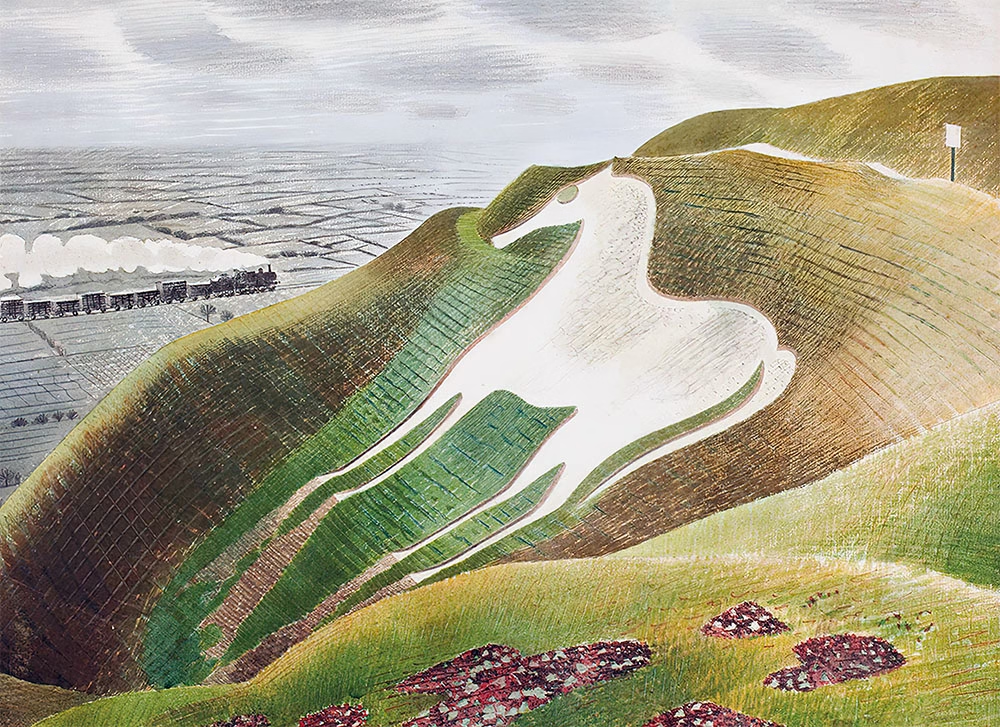
However a closer look at the White Horse in Train Landscape will reveal that the ear, if not entirely missing, is reduced to a suggestion, the eye has gone, as have the ramparts of the hillfort.
These missing features have always nagged at me a little. The horse itself is much closer to the real hill figure, with the exception of the missing eye, but the contours of the hillfort and hill above were the sort of feature that Ravilious revelled in. It didn’t seem like the kind of feature he’d miss at all. And what is more, the geography was very reminiscent of the South Downs of East Sussex.
I’m familiar with this stretch of chalkland, as I grew up in Sussex. My parents would often drive out from Brighton on a Sunday afternoon for long walks around Wilmington, so my brother and I could play in a favourite chalk quarry, and end the afternoon in the beer garden of the Sussex Ox in Milton Street, a hamlet so small it has no other name than the street that runs through it. In later years I took an archaeological interest in the prehistory of the same area, and later still the art of Eric Ravilious, so much of it detailing familiar places, and drawing me back to my childhood hills again.
In short, I knew the real landscape well, and was very familiar with the landscapes painted by Ravilious, and I was fairly convinced that the landscape of Train Landscape was here, above the Wilmington Giant,* and not adorning an escarpment on Salisbury Plain. So when I was leafing through a book of the letters of Eric Ravilious and happened across this image, it was a bit of a surprise, to say the least. As a lapsed archaeologist I can say it’s not often something you have long supposed to be true is suddenly proven to be the case. Hypotheses are ten a penny, but corroborating evidence generally remains elusive, if not entirely absent. So the new picture, and Tirzah’s quote made sense of what was a minor artistic puzzle.
The differences are striking though – in addition to the chalk figures being swapped, the complex pattern of the upholstery has disappeared, to be replaced by a plainer pale stripey affair, though some half diamond shapes can still be discerned. And where the upholstery climbed the wall of the carriage either side of the door, we now have bare boards. The rolls of the blinds above the windows have also changed and become better defined. But all of these details, even the obvious changes in the fabric of the seats, were only noticed after the change of view.
Why Ravilious decided to paint two almost identical views and swap hill figures raises further questions however. Why transport a hill figure from Wiltshire to East Sussex, and transpose it over a space which is, in reality, occupied by the Wilmington Giant at all?
I don’t think the answer to this question will ever be found, and in the grand scheme of things isn’t perhaps all that important, particularly when it could reasonably answered with a shrug of the shoulders and a ‘why not?’
And why not indeed? And if we’re going that far, there is another possibility, though I don’t suggest it’s anything but food for thought. If you’re happy transposing a Wiltshire hill figure onto a Sussex landscape, why not go further? We know there was no red van in his Wiltshire Landscape. When he got back from the Wiltshire expedition he thought the scene looked a bit bleak, and painted in a red van from his scrap-book, an illustration which had originally graced the pages of a toy catalogue (more of this another time). So things in Ravilious paintings needn’t adhere to locations or scale. So to complicate matters further. . .
From the top of the hill upon which the Giant resides, if you look South-South-West down the Cuckmere Valley, you can see another chalk horse on a downland slope. The Litlington Horse can’t be seen from a train, as there are none near it, but you have to pass it when walking from Alfriston to Cuckmere Haven, a favourite spot of the artist. Who’s to say a bit of Litlington didn’t make it into the picture as well?

*This hill figure is known locally as The Giant, or the Wilmington Giant, and less so The Long Man of Wilmington, though that’s how it usually appears in the literature. Ravilious called it the Wilmington Giant, as he was never convinced the hips were particularly male.

A fascinating article! Thank you.
You might be interested in my poem inspired by this painting, published in ‘Lighten Up Online’
https://lightenup-online.co.uk/index.php/2025/issue-71-september-2025/gwen-owen-train-landscape?highlight=WyJnd2VuIiwib3dlbiJd
Wonderful story. I thoroughly enjoyed learning not only about the painting and painter but the writer as well.
There was a wonderful exhibition at Wiltshire Museum in Devizes back in late 2021 entitled ‘Eric Ravilious: Downland Man” describing the very similar landscapes of that part of Wiltshire (particularly the ridge on the north of Salisbury Plain) which has a very similar look and feel to the landscapes around the part of Sussex you mention, and that Ravilious was inspired by both . The main Paddington to Westbury line has a very similar vibe at this point as the train from Eastbourne to Lewes. Having lived for a number of years in Lewes, also Alfriston and Edington -the village next to Bratton, when I was younger (oh, and also a lapsed archaeologist) I know all these landscapes well. Personally, I don’t see the locally anomalous white horse south of Alfriston (maybe best viewed from Litlington) as a particular influence to the images you mention (just take the train past both Westbury and Wilmington and you’ll get the idea), I hope that Ravilious was as equally struck as myself by there being a ‘Westbury’-style white horse at all in Sussex. There’s a whole landscape of chalk horses from Westbury up to the edges of Oxfordshire, of various styles and ages, but I can’t think of any other ones on the Sussex Downs.
One more thing, the Westbury house is at an oblique angle from the train, unlike the Wilmington Giant, so when viewed from the train it’s much more difficult to get the detail of ear and eye.
Thank you for this article. I really enjoyed it as a huge Ravilious fan. You could have written it just for me.